

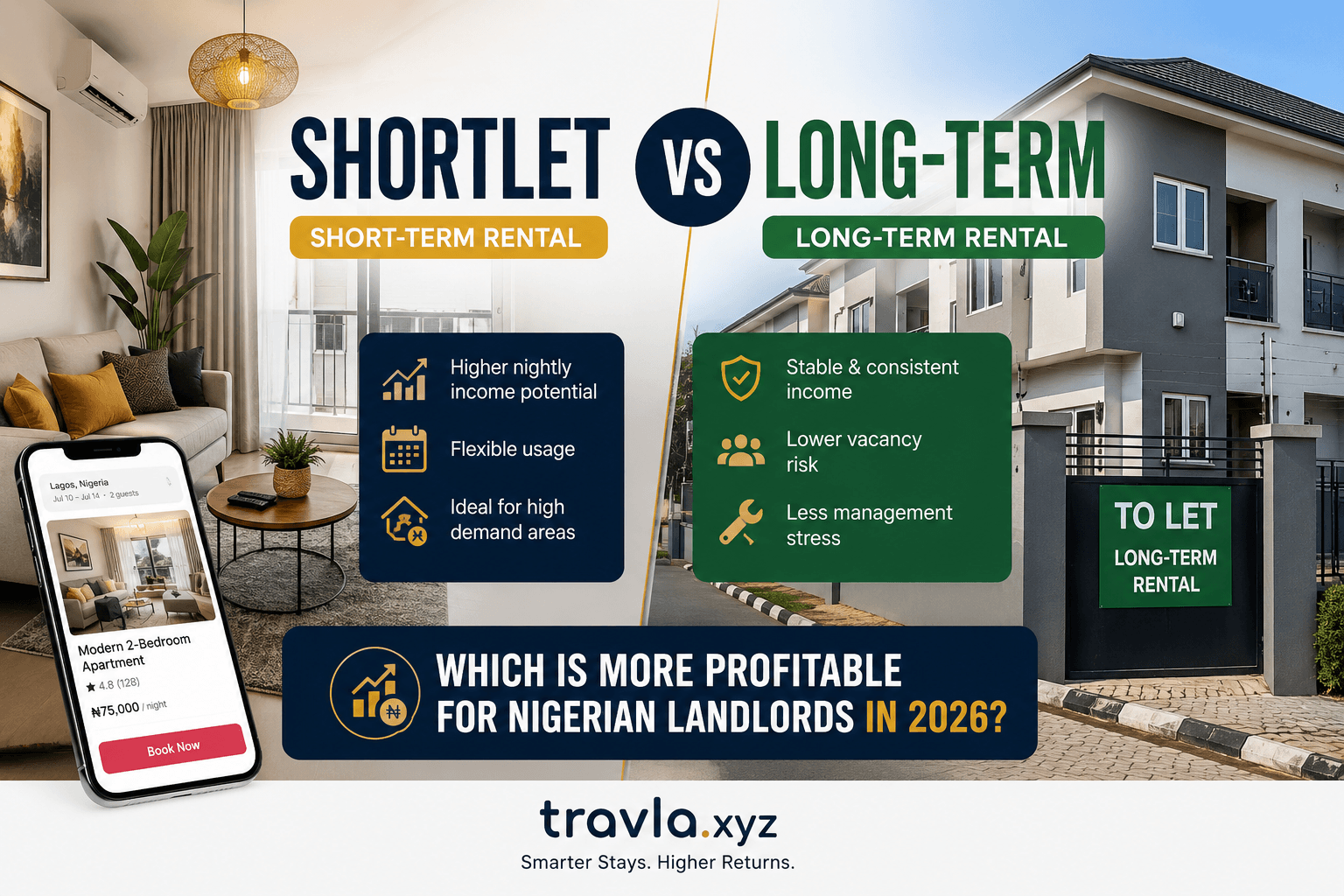
If you own property in Nigeria right now, you are sitting on one of the most interesting decisions a landlord can face in this economy: do you rent it out the traditional way and collect a yearly tenancy, or do you open it up as a shortlet and cash in on the growing demand for flexible accommodation?
It sounds like a simple question, but the answer is anything but. Both options have real money on the table — and real risks too. The right choice depends on your property type, your location, how hands-on you want to be, and honestly, how well you understand what each model actually requires.
This article breaks it all down for you. No fluff, no theory — just a clear, honest comparison so you can make the decision that actually works for your situation in 2026.
Table of Contents
What Is a Shortlet Apartment?
A shortlet apartment is a fully furnished residential space rented out on a short-term basis — typically anywhere from one night to a few months. Think of it as a hotel alternative, except guests get a full apartment experience: a kitchen, living room, private bathroom, and all the comforts of home.
In Nigerian cities like Lagos, Abuja, and Port Harcourt, shortlets have exploded in popularity over the last five years. Business travellers, relocating professionals, visiting families, and even locals looking for a weekend staycation now routinely book shortlets over hotels.
Platforms like Travla.xyz have made it easier than ever for property owners to list their spaces and reach verified guests directly.
What Is a Long-Term Rental?
A long-term rental is the traditional Nigerian landlord model — you rent your property to a tenant for a fixed period, usually one or two years at a stretch, collect the rent upfront, and largely step back from day-to-day management.
This is how most Nigerian landlords have operated for decades. It is familiar, predictable, and requires relatively little ongoing effort once a good tenant is in place.
The Income Comparison: Which Actually Pays More?
Let us get straight to the numbers, because this is where most landlords make or break their decision.
Take a two-bedroom apartment in Lekki Phase 1, Lagos, as an example. At the time of writing, a similar unit rented long-term would go for somewhere between ₦3.5 million and ₦5 million per year, depending on the finishing and exact location. That works out to roughly ₦291,000 to ₦416,000 per month.
That same apartment listed as a shortlet could realistically command between ₦80,000 and ₦150,000 per night, depending on furnishing quality, amenities, and season. Even at a conservative 50% occupancy rate — meaning the apartment is booked only 15 nights per month — you are looking at ₦1.2 million to ₦2.25 million per month.
The gap is not small. On paper, shortlets win the income comparison by a significant margin in high-demand locations.
But — and this is a big but — that income does not arrive without costs attached.
The Real Costs of Running a Shortlet
This is where many first-time shortlet hosts get caught off guard. The gross income from a shortlet looks impressive. The net income, after expenses, is what you actually take home.
Here are the costs you need to account for:
Furnishing and Setup: To attract the kind of guests who will pay premium shortlet rates, your apartment needs to be properly furnished. We are talking quality beds, functional kitchen appliances, a reliable television, fast WiFi, air conditioning in every room, a washing machine, and aesthetically pleasing decor. Getting a two-bedroom apartment properly set up for shortlet use in Lagos can cost anywhere from ₦2 million to ₦6 million depending on your taste and suppliers.
Utility Bills: Unlike long-term rentals where tenants typically handle their own electricity and water bills, shortlet hosts absorb all utility costs. NEPA being what it is in Nigeria, running a generator is not optional if you want good reviews. Fuel costs alone can eat significantly into your monthly revenue.
Cleaning and Laundry: Every guest checkout requires a full clean and fresh linen. If you are managing multiple bookings per month, you are either paying a cleaner per turnover or hiring someone part-time. This adds up faster than most people expect.
Maintenance: Guests use appliances, furniture, and fixtures intensively. Things break more often than in a long-term rental. You need to be ready to respond quickly when something stops working, because bad reviews are very difficult to recover from.
Platform Fees and Marketing: If you list on platforms, expect to pay a commission on each booking. Even if you manage bookings directly, you need to invest in good photography, occasional promotions, and responsive communication.
Property Management: If you do not want to manage the property yourself, professional shortlet management companies typically charge between 20% and 30% of gross revenue.
Once all these costs are factored in, your net income from a shortlet is still likely to beat long-term rental in a good location — but the margin is not always as dramatic as the gross figures suggest.
The Real Costs of Long-Term Rental
Long-term rental is not entirely cost-free either, though the costs are different in nature.
Vacancy Periods: When a tenant leaves, finding a new one takes time. In a slow market, you could go two to four months without income. That gap can hurt, especially if you have loan repayments or other financial commitments tied to the property.
Difficult Tenants: Every long-term landlord in Nigeria has a story. Late payments, property damage, refusal to vacate — these are real risks. Eviction processes in Nigeria can be slow, expensive, and frustrating.
Unpaid Rent and Legal Costs: If a tenant defaults, recovering rent legally can take months and cost you more than the arrears themselves.
Depreciation Without Control: Long-term tenants often handle the property in ways a landlord would never approve, and since you are not checking in regularly, damage can accumulate quietly over years.
Location Matters More Than Almost Anything Else
The shortlet model does not work equally well everywhere. It thrives in specific types of locations:
Areas with high business travel activity, such as Victoria Island, Lekki, and Maitama in Abuja, see consistently high shortlet demand from corporate visitors.
Areas near airports or major transport hubs attract travellers who need a one or two night stop.
Areas known for leisure and entertainment attract weekend bookings and staycation guests.
In contrast, a property located in a residential suburb with low tourist or business traffic may struggle to maintain the occupancy rate needed to outperform a long-term rental.
If you are still figuring out whether your area is a good fit for shortlets, our guide on the best shortlet apartments in Lekki (https://travla.xyz/best-shortlet-apartments-in-lekki/) and the cheapest areas to get shortlet apartments in Lagos (https://travla.xyz/cheapest-areas-to-get-shortlet-apartments-in-lagos-2026-guide/) can give you a useful reference point for demand patterns across different neighbourhoods.
Time and Effort: The Honest Conversation
This is the part that some shortlet enthusiasts gloss over, and it is important to address it directly.
Running a shortlet is essentially running a small hospitality business. You are not just a landlord — you are a host. That means responding to booking enquiries promptly, coordinating check-ins and check-outs, managing cleaning schedules, restocking supplies, handling maintenance issues, and maintaining your listing quality to stay competitive.
If you have a full-time job or multiple properties to manage, this can become genuinely overwhelming without proper systems or staff in place.
Long-term rental, by comparison, is largely passive once a tenant is settled. You collect rent, address maintenance when called upon, and renew the agreement when the time comes. It demands far less of your daily attention.
The question is not which model pays more in theory. The question is which model you can realistically sustain given your time, temperament, and management capacity.
Risk Profile: Which Is Safer?
Both models carry risk, but the risks are distributed differently.
Shortlet risks are operational and immediate. A bad month with low bookings means low income. A difficult guest can cause property damage. A competitor opening a better-furnished apartment nearby can hurt your occupancy rate overnight.
Long-term rental risks are slower but can be more damaging. A defaulting tenant who refuses to leave is a legal and financial crisis. An eighteen-month legal battle to reclaim your property is not a hypothetical — it happens regularly in Nigerian courts.
One way to think about it: shortlet risk is more visible and manageable in real time. Long-term rental risk can hide quietly until it becomes very serious.
For landlords who want to reduce the risk of difficult tenants, working with verified platforms is a smart move. Travla’s verification approach, explained in detail here (https://travla.xyz/how-travla-ensures-safe-verified-shortlet-listings-in-nigeria/), gives hosts an additional layer of protection when listing their properties.
Tax and Legal Considerations
Nigerian property income is taxable under the Personal Income Tax Act, and this applies whether you run a shortlet or a traditional rental. However, shortlet income is more visible, especially if you operate through digital platforms that process payments electronically.
As a shortlet host, it is worth consulting a tax professional to understand how to properly declare your income, what expenses are deductible, and how to stay compliant without overpaying. The Nigerian tax environment is evolving, and staying ahead of it protects you from surprises.
For long-term rentals, rent received upfront for multiple years is technically taxable in the year received under strict interpretation, though enforcement varies. Again, professional advice is valuable here.
What About Property Wear and Tear?
This is a consideration that does not get enough attention in most comparisons.
Shortlet properties generally experience faster surface-level wear — furniture, appliances, and decor take more frequent use from many different guests. However, because you inspect and refresh the property regularly, problems are caught and resolved early.
Long-term rental properties can experience slower visible wear but may suffer deeper structural neglect if a tenant is careless or indifferent. A bathroom that drips for two years or a kitchen that accumulates grease without proper cleaning can cause damage that is costly to reverse.
Neither model automatically protects your property better than the other. Both require landlord vigilance, just at different intervals.
A Hybrid Approach: Getting the Best of Both
Some savvy Nigerian landlords are not choosing one model exclusively — they are running both simultaneously across a portfolio.
The approach typically works like this: one property, usually in a high-demand area with strong furnishing, runs as a shortlet to capture premium nightly income. Another property, perhaps in a more residential area or with an older finish, runs as a long-term rental to provide stable, predictable income.
This way, the shortlet revenue provides upside, and the long-term rental provides a floor. The risks of each model offset each other to some degree.
If you are thinking about starting a shortlet business from scratch to complement an existing rental portfolio, our comprehensive guide on how to start a shortlet business in Nigeria (https://travla.xyz/how-to-start-a-shortlet-business/) walks through everything you need to know before you begin.
When Long-Term Rental Makes More Sense
Despite the income potential of shortlets, there are genuine situations where long-term rental is the smarter choice.
Your property is in a low-traffic residential area with minimal tourist or business demand. You live far from the property and cannot manage or supervise it easily. You do not have the capital to furnish and equip the apartment to shortlet standards. You prefer simplicity and predictability over maximising income. You already have a reliable, responsible tenant in place who pays on time.
In these cases, forcing a shortlet model can result in stress, poor reviews, and lower net income than a straightforward long-term tenancy would have provided.
When Shortlet Makes More Sense
On the other side, shortlets tend to be the right move when:
Your property is in Lagos Island, Lekki, Victoria Island, Abuja’s Maitama or Wuse, or another area with documented shortlet demand. You have the capital or are willing to invest in quality furnishing. You are prepared to manage the property actively or hire someone to do so. You want to retain flexibility — perhaps to eventually sell, use the property yourself seasonally, or convert it back to long-term use. You want to build an income stream that grows with your reputation and reviews over time.
The Verdict
There is no universal answer, and any article that tells you one model is definitively better than the other without knowing your specific situation is oversimplifying the conversation.
What is true in 2026 is this: in the right location, with the right setup and management, shortlet properties in Nigeria can generate significantly more income than traditional long-term rentals. The demand is real, the platforms are better than ever, and Nigerian travellers are increasingly comfortable booking shortlets over hotels.
But long-term rental remains a legitimate, lower-effort strategy that suits many landlords very well — particularly those who value stability over optimisation, or who own properties in locations where shortlet demand is limited.
The best approach is to assess your specific property honestly, understand what each model actually demands of you, and choose the one that aligns with both your financial goals and your capacity to execute.
If you are leaning towards the shortlet route and want to understand what verified, well-managed hosting looks like in practice, you can explore active shortlet listings on Travla.xyz (https://travla.xyz/explore/?type=shortlets) to see the standard guests currently expect — and what successful hosts are offering to meet it.
Useful Resources
To help you go deeper on the topics covered in this article, here are some further reads worth bookmarking:
How to Find Verified Shortlets in Nigeria and Avoid Scams in 2026 — https://travla.xyz/how-to-find-verified-shortlets-in-nigeria-avoid-scams-in-2026/
7 Things to Check Before Booking a Shortlet in Nigeria — https://travla.xyz/7-things-to-check-before-booking-a-shortlet-in-nigeria/
Top 10 Verified Shortlet Apartments in Lagos with Prices in 2026 — https://travla.xyz/top-10-verified-shortlet-apartments-in-lagos-with-prices-in-2026/
Best Shortlets in Abuja for Business and Leisure Travelers — https://travla.xyz/best-shortlets-in-abuja-for-business-leisure-travelers/
Nigerian Investment in Real Estate Online: A Beginner’s Guide — https://travla.xyz/how-to-invest-in-real-estate-online-a-beginners-guide/
For external context and industry data, the following resources are also worth exploring:
PricewaterhouseCoopers Nigeria Real Estate Report — https://www.pwc.com/ng/en/assets/pdf/real-estate-2023.pdf
Nigerian Investment Promotion Commission — https://nipc.gov.ng
FIRS Tax Guide for Landlords — https://www.firs.gov.ng
Introduction The shortlet business in Lagos is booming — driven by tourism, business travel, and the demand for flexible accommodation. Read more

If you've been searching for a comfortable place to stay in Lagos, chances are Lekki has already caught your attention. Read more

Let's be honest — booking a shortlet apartment in Nigeria should be simple. And most of the time, it is. Read more

Let me be straightforward with you: the shortlet apartment market in Nigeria has exploded. In cities like Lagos, Abuja, and Read more