

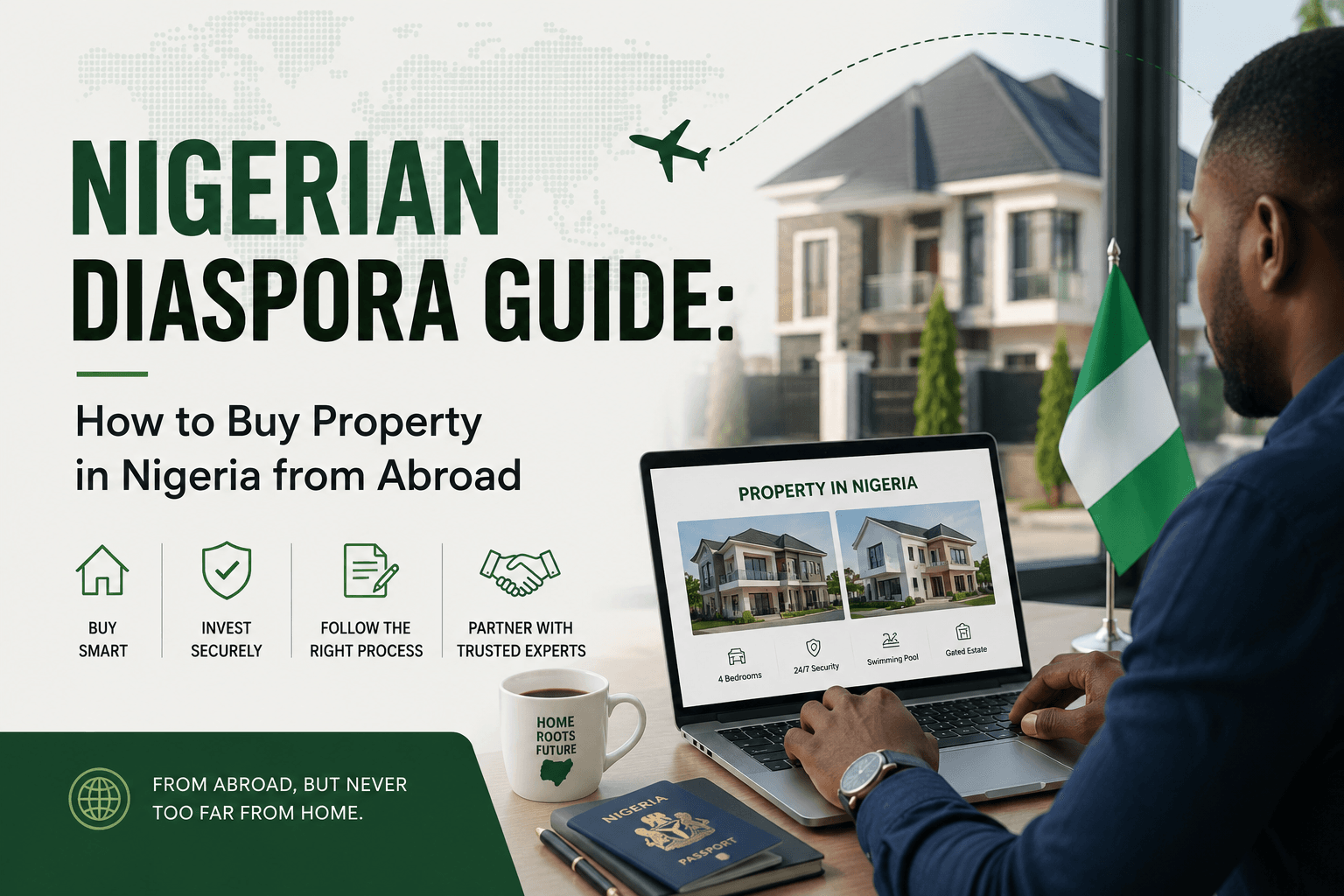
There is something quietly powerful about a Nigerian living abroad who decides to invest back home. It is not just a financial decision. It is a statement of faith in the country, a connection to roots, and for many people, the beginning of a plan to eventually return, whether in five years or twenty five.
But let us be equally honest about what that decision looks like in practice. Buying property in Nigeria from abroad is one of the most emotionally loaded and practically complicated financial moves a member of the Nigerian diaspora can make. The distance creates real vulnerability. The legal landscape is unfamiliar to many. The risk of being defrauded by someone you trusted is not hypothetical. It happens regularly, and it happens to intelligent, careful people who simply did not know what they did not know.
This guide exists to close that knowledge gap. If you are a Nigerian living in the United Kingdom, the United States, Canada, Ireland, Australia, or anywhere else in the world, and you are thinking seriously about buying property back home, this is the most thorough and honest guide you will find. We are going to cover the legal process, the documents you need, the risks you must understand, the trusted channels you should use, and the practical steps that protect your money and give your investment the best possible foundation.
Why Nigerians in the Diaspora Are Buying Property at Home
Before the process, the context. Understanding why this trend is accelerating helps frame the decisions you are about to make.
The naira has depreciated significantly against the dollar, pound, and euro over the last several years. For Nigerians earning in foreign currencies, this has created a situation where Nigerian property, priced in naira, has become significantly more affordable in real terms from abroad. A property that costs fifty million naira represents a very different financial commitment to someone earning in British pounds today than it did five years ago.
At the same time, Nigerian property values in key urban markets have continued to rise in naira terms, meaning that early investors in Lagos, Abuja, and Port Harcourt have seen strong nominal returns even as the currency has weakened.
The combination of currency advantage and naira denominated asset appreciation has made Nigerian real estate genuinely attractive to diaspora investors who understand both sides of the equation.
Beyond pure investment logic, many Nigerians abroad are buying for deeply personal reasons. They are building a home to return to. They are securing an inheritance for children who may have been born abroad but have Nigerian roots. They are honouring promises to parents or siblings. They are hedging against an uncertain future in a country that, for all its opportunities, is not always a guaranteed permanent home.
Whatever your reason, the process demands the same level of careful preparation.
Understanding the Nigerian Property Market Before You Spend a Single Naira
The most expensive mistake diaspora buyers make is approaching the Nigerian property market with assumptions shaped by the markets they live in abroad.
In the United Kingdom, property transactions are governed by a clear legal framework, handled by regulated solicitors, protected by government backed registries, and supported by institutional mortgage infrastructure. If something goes wrong, there are systems of redress.
In Nigeria, the framework exists but operates differently. Land ownership is governed by the Land Use Act of 1978, which vests all land in each state in the hands of the state governor, meaning that what individuals own is not land itself but a right of occupancy over land. This is a critical distinction that shapes every property transaction in the country.
Beyond the legal framework, the Nigerian property market operates with significantly less transparency than mature markets abroad. Prices are not publicly listed in any standardised registry. Agent commissions are not regulated. Title verification requires manual searches through state land registries that are not always digitised. And the existence of multiple, sometimes conflicting, documentation types creates genuine confusion even for experienced local buyers.
None of this means the market is impossible to navigate. Millions of Nigerians buy and sell property successfully every year. But it does mean that diaspora buyers who approach the market without adequate local knowledge and professional support are exposed to risks that informed buyers can significantly reduce.
The Most Important Legal Concepts Every Diaspora Buyer Must Know
Before you look at a single property listing, you need to understand the following legal concepts that govern Nigerian real estate transactions.
The Land Use Act and Right of Occupancy
As mentioned, the Land Use Act of 1978 means that the state owns all land, and individuals hold either a statutory right of occupancy (granted by the state governor, applicable to urban land) or a customary right of occupancy (applicable to rural land). When you buy property in Nigeria, you are technically acquiring a right of occupancy, not land ownership in the Western sense.
The practical implication is that any transaction involving urban land requires the governor’s consent to be legally valid. Without the governor’s consent, a property transfer is not legally recognised, regardless of what documents are signed between buyer and seller.
Certificate of Occupancy
The Certificate of Occupancy, commonly called C of O, is the most important title document in Nigerian real estate. It is issued by the state government and represents the holder’s statutory right of occupancy over the land. A property with a registered C of O in the name of the seller, verified against the state land registry, is the most straightforward title situation a buyer can encounter.
You can read more about the process of obtaining a Certificate of Occupancy and what it means for property owners in Nigeria in this detailed guide on how to get a Certificate of Occupancy in Nigeria.
Deed of Assignment
When a property is sold, the legal document transferring the right of occupancy from seller to buyer is called a Deed of Assignment. This document must be prepared by a lawyer, signed by both parties, and registered with the appropriate state land registry. Without registration, the transfer has limited legal standing.
Governor’s Consent
For any transfer of a statutory right of occupancy to be legally valid, the governor of the relevant state must give consent to the transaction. In practice, this process is handled through an application to the state Ministry of Lands, supported by the relevant documentation. The consent process takes time and involves fees, but skipping it means your title is defective from a legal standpoint.
Survey Plan
A survey plan is an official map of the land prepared by a licensed surveyor, showing the exact boundaries, dimensions, and location of the property. It is one of the foundational documents in any property transaction and is required for the C of O application process. Understanding how to get a survey plan in Nigeria is an essential part of due diligence that every buyer must take seriously, and you can find a step by step breakdown of how to get a survey plan in Nigeria to guide you through what is involved.
Other Title Documents
Beyond the C of O, Nigerian property may be held under various other documentation types including a Deed of Conveyance (common in older transactions pre dating the Land Use Act), a Governor’s Consent document, a Gazette, a Court Judgment vesting property, or in some cases a combination of these documents with an ongoing C of O application. Each situation requires professional legal assessment before any money changes hands.
For a comprehensive overview of the key documents involved in Nigerian property transactions and what each one means, the article on important documents used in real estate transactions in Nigeria is a useful starting point.
Building Your Team: Who You Need on the Ground
No diaspora buyer should attempt to purchase Nigerian property without a reliable team of professionals operating on their behalf in Nigeria. The distance makes self navigation genuinely dangerous. The good news is that building the right team is not complicated, but it does require care in selection.
A Real Estate Lawyer
This is the single most important appointment you will make in the entire process. Your lawyer’s role is to conduct title verification at the state land registry, identify any encumbrances or adverse claims on the property, review and draft the purchase agreement, prepare the Deed of Assignment, facilitate the governor’s consent application, and ensure every document is properly registered.
Your lawyer should be registered with the Nigerian Bar Association and ideally have verifiable experience handling property transactions in the specific state where you are buying. Lagos property law and practice differs from Abuja, which differs from Rivers State.
Do not use the seller’s lawyer. Do not use a lawyer recommended exclusively by the agent selling you the property. Find your own independent legal representation whose sole obligation is to protect your interests.
A Licensed Real Estate Agent
A reputable, licensed real estate agent with knowledge of the specific market where you are buying provides invaluable local intelligence, access to legitimate listings, and guidance on fair market pricing. They should be registered with the relevant professional body such as the Nigerian Institution of Estate Surveyors and Valuers (NIESV) or the Real Estate Developers Association of Nigeria (REDAN).
A Surveyor
An independent licensed surveyor should verify the survey plan provided by the seller and confirm that the physical boundaries of the property match what the documentation describes. Encroachment disputes between neighbouring properties are a real risk in Nigeria, and an independent survey is insurance against this.
A Trusted Local Representative
Beyond the formal professionals, most diaspora buyers benefit from having a trustworthy family member, close friend, or professional property manager who can physically visit the property, attend meetings when needed, provide honest ground level feedback, and serve as your eyes and ears throughout the process. This person should be someone whose judgment you trust absolutely, not someone with a financial interest in the sale proceeding.
If you want to understand what qualities to look for in a real estate agent in Nigeria specifically, the article on how to choose the right real estate agents in Nigeria covers the key criteria in detail.
The Step by Step Process for Buying Property in Nigeria from Abroad
With your team assembled, here is the actual process, broken into its key stages.
Stage One: Define Your Investment Goals Clearly
Before you search for a single property, be specific about what you are trying to achieve. Are you buying land to build on eventually? A completed apartment to use as a shortlet and generate rental income while you are abroad? A family home to return to? A commercial property? Each of these goals points to different property types, different locations, different price ranges, and different risk profiles.
Your goal also shapes how much involvement you need from a property manager in Nigeria during the period between purchase and your eventual return or use of the property.
Stage Two: Set a Realistic Budget
Your budget should be set in naira, but calculated with awareness of current exchange rates and the expected timeline of your purchase. The naira exchange rate can shift significantly over even a few months, and your foreign currency budget needs to be converted at the actual rate available to you, not the Central Bank of Nigeria official rate, which may differ from the rates available through commercial channels.
Beyond the purchase price, your budget must include:
Legal fees, typically between five and ten percent of the property value for a full transaction including title verification, Deed of Assignment preparation, and registration.
Agency commission, typically around ten percent of the purchase price payable to the selling agent.
Survey fees for an independent survey plan verification.
Governor’s consent fees, which vary by state.
Stamp duty on the transaction documents.
Registration fees at the state land registry.
Any development levy or estate service charges if buying within a gated estate.
These transaction costs can add fifteen to twenty five percent to your headline purchase price in total. Budget for them from the beginning rather than being surprised by them at the point of completion.
For a detailed picture of the full property buying process in Nigeria including typical costs, the article on how to buy a house in Nigeria covers the end to end process in accessible detail.
Stage Three: Identify Properties Through Legitimate Channels
As a diaspora buyer, you are particularly vulnerable to property scams because your inability to visit and verify in person creates opportunity for fraudsters. The channels through which you identify properties significantly affect your risk exposure.
Legitimate channels include:
Reputable real estate agencies in Nigeria with verifiable office addresses, professional body registration, and a track record you can independently verify.
Property listing platforms that verify their listings and have transparent processes for handling disputes.
Referrals from trusted family or friends in Nigeria who have personally dealt with the agent or developer.
Direct contact with registered property developers for off plan or new build purchases.
Channels to approach with extreme caution include:
Social media listings with no verifiable agency background or professional identity.
WhatsApp group listings where the seller cannot be independently verified.
Unsolicited approaches from individuals claiming to have off market deals available exclusively to diaspora buyers.
Properties advertised at prices dramatically below the verifiable market rate for the area. If the price seems too good to be true, it is almost always because it is.
For a comprehensive understanding of the real estate scams that operate in Nigeria and how to identify and avoid them, the article on top real estate scams in Nigeria and how to avoid them is essential reading before you commit to any transaction.
Stage Four: Conduct Due Diligence Before Any Payment
This stage is where your lawyer earns their fee and where many diaspora buyers make the costly mistake of skipping steps because they trust the person introducing them to the property.
Due diligence for a Nigerian property purchase includes:
Title search at the state land registry to confirm that the person selling the property is the legitimate title holder and that the title is free of encumbrances, court orders, or adverse claims.
Physical inspection of the property, conducted either by your trusted local representative or an independent professional. Never buy based solely on photographs or a video call controlled by the seller.
Verification of the seller’s identity. Confirm that the person you are dealing with is who they say they are and that their identity matches the name on the title documents.
Confirmation that the property is not subject to any government acquisition order. In some Nigerian states, properties in certain areas have been earmarked for infrastructure development, and a buyer unaware of this can lose their investment when the government exercises its acquisition rights.
Verification of the survey plan against the actual physical boundaries of the property.
Enquiry into any outstanding service charges, estate levies, or utility debts attached to the property that would transfer to you as the new owner.
Stage Five: Negotiate and Agree Terms
Once due diligence is satisfactory, your lawyer should be involved in negotiating and documenting the terms of the purchase including the agreed price, the payment schedule if payment is staged, what is included in the sale (fixtures, fittings, existing furniture if relevant), the timeline for completion, and the process for handling any title defects discovered after the agreement is signed.
Negotiating from abroad can feel like a disadvantage, but in reality the key negotiation happens through your lawyer and your local representative. Your absence from the room is less important than the quality of the people representing your interests within it.
For insights on how to negotiate property deals effectively in the Nigerian context, the guide on 10 ways to negotiate a real estate deal like a pro provides practical tactics relevant to the Nigerian market.
Stage Six: Execute the Purchase Agreement and Pay
The formal purchase begins with a written agreement, typically called a Contract of Sale or Purchase Agreement, prepared by your lawyer. This document sets out all agreed terms and is signed by both parties before any payment is made beyond an initial deposit if applicable.
Payment from abroad requires careful attention to the mechanics of international money transfer into Nigeria. Options include:
Domiciliary account transfers through Nigerian commercial banks. If you have a domiciliary account in Nigeria, you can transfer foreign currency from abroad into your Nigerian account and then convert it for the purchase.
International wire transfer directly to the seller’s designated account, documented clearly and with all transfer records preserved.
Use of regulated fintech transfer services for smaller amounts, subject to transaction limits.
Whatever payment method you use, keep records of every transfer, every conversion, and every payment instruction. These records are important for legal documentation and may be required if any dispute arises.
Never pay cash in full outside of a documented, legally framed transaction. Never pay to an individual account without your lawyer’s explicit sign off on the legitimacy of that payment arrangement.
Stage Seven: Complete the Legal Transfer
After payment, the legal transfer process involves your lawyer preparing and executing the Deed of Assignment, filing the application for governor’s consent, and registering the completed transaction documents at the state land registry.
This process takes time. Governor’s consent applications in Lagos, for example, can take several months to complete. Do not interpret the delay as a problem. It is normal. What matters is that the application has been properly filed and is being tracked by your lawyer.
Once the governor’s consent is granted and the documents are registered, you are the legally recognised holder of the right of occupancy over the property. At that point, the transaction is legally complete.
Protecting Your Property After Purchase
Buying the property is only the first part of the challenge for diaspora investors. Protecting and managing it from abroad requires ongoing attention.
Appoint a Reliable Property Manager
Whether your property is intended as a rental, a shortlet, or a future family home that will sit empty for now, having a trusted property manager in Nigeria is not optional. An empty property without local oversight attracts squatters, deteriorates faster than occupied properties, and becomes a target for the kind of land grabbing that is unfortunately not uncommon in some Nigerian cities.
A professional property manager handles rent collection if the property is tenanted, maintenance oversight, regular property inspection, utility management, and communication with you as the owner.
If you intend to run the property as a shortlet to generate income while you remain abroad, a shortlet management company can handle the full guest experience on your behalf. For an understanding of what the shortlet model looks like in practice and how to make it work profitably, the guide on how to start a shortlet business in Nigeria is a practical resource worth reading in full.
Insure Your Property
Property insurance in Nigeria is available but underutilised. A comprehensive property insurance policy protects your investment against fire, flooding, third party liability, and other risks. Given that you are managing the property from thousands of kilometres away, insurance is a meaningful risk management tool.
Document Everything
Keep digital copies of every document related to your property in a secure, accessible location. This includes the title documents, the Deed of Assignment, the governor’s consent letter, the survey plan, all payment records, your property management agreement, and any correspondence with lawyers, agents, or developers. These documents are your evidence of ownership and your protection against any future adverse claim.
Stay Informed About Property Tax and Charges
Nigerian property owners are subject to land use charge in states like Lagos, property rates in some states, and various other levies. Staying current on these obligations protects you from penalties and keeps your title in good standing. Your property manager or lawyer should be able to advise on your specific obligations in the state where your property is located.
Common Mistakes Diaspora Property Buyers Make
To save you from the lessons others have learned at significant cost, here are the most common errors made by Nigerian diaspora property buyers:
Trusting too quickly and verifying too slowly. Emotional connection to a property, or to the person introducing it, is not a substitute for legal due diligence. Verify first, trust after.
Paying in full before title verification is complete. No responsible lawyer will advise this. Do not let anyone pressure you into full payment before the title is clean.
Using a family member as your only representation without professional support. A trusted family member is valuable but is not a replacement for an independent lawyer and surveyor.
Buying land in areas prone to government acquisition without checking the acquisition status.
Ignoring the governor’s consent process because it takes too long and feels bureaucratic. Skipping governor’s consent leaves your title legally defective regardless of what other documents you hold.
Choosing a property based on photographs and the seller’s description without an independent physical inspection.
Underestimating transaction costs and being financially unprepared for the full total spend required to complete the purchase.
For a broader understanding of the due diligence process and what thorough property research looks like in the Nigerian context, the article on factors to consider when searching for a property to buy covers the key considerations comprehensively.
Financing Options for Diaspora Property Buyers
Most diaspora buyers fund Nigerian property purchases through personal savings in foreign currency, converted at the point of purchase. However, there are other financing mechanisms worth understanding.
Nigerian bank mortgages are available in principle but present practical challenges for diaspora buyers, including the requirement for Nigerian income documentation, high interest rates relative to what buyers are used to in their countries of residence, and loan to value ratios that are typically lower than what Western mortgage markets offer.
Some Nigerian developers offer instalment payment plans for off plan or newly completed properties. These can be an accessible entry point, allowing you to spread the purchase cost over six to twenty four months while the property is completed. However, buying off plan requires thorough developer due diligence, as project delays and developer insolvency are risks in the Nigerian market.
Diaspora mortgage products have been discussed at the policy level in Nigeria for several years, with the Federal Mortgage Bank of Nigeria periodically discussing products specifically designed for Nigerians abroad. Checking the current status of these products directly with FMBN is advisable.
For a comprehensive overview of the financing options available for Nigerian property purchases, the article on top financing options for buying properties in Nigeria covers the landscape in useful detail.
Shortletting Your Nigerian Property While Abroad: A Smart Income Strategy
One of the most practical ways for diaspora investors to make their Nigerian property work financially from day one is to list it as a shortlet apartment, generating naira income that can be used to cover local costs such as property management fees, maintenance, and land use charges, while the asset appreciates.
The shortlet model is particularly well suited to diaspora owned properties because it does not require a long term tenant commitment, allows the owner to use the property during visits home, and generates income that is proportional to demand rather than fixed at a negotiated annual rent.
A well managed two bedroom shortlet in Victoria Island, Lekki, Abuja GRA, or Port Harcourt GRA can generate between one million and three million naira per month in gross revenue at current market rates, depending on occupancy and pricing. Even after management fees and operating costs, the net return can comfortably outperform what a long term annual rental would yield.
For diaspora buyers who want to understand the comparison between shortlet and long term rental income in the Nigerian market, and which model makes more sense for their specific property and situation, that analysis is worth exploring carefully before deciding on your rental strategy.
To see what verified shortlet listings across Nigeria currently look like and what guests are paying, browsing shortlet listings on Travla.xyz gives you a real time picture of the market.
External Resources for Nigerian Diaspora Property Buyers
Federal Mortgage Bank of Nigeria for information on mortgage products available to Nigerians including diaspora mortgage discussions: https://www.fmbn.gov.ng
Nigerian Investment Promotion Commission for foreign investment guidelines and diaspora investment facilitation: https://nipc.gov.ng
Lagos State Land Bureau for title verification and governor’s consent processes in Lagos State: https://lands.lagosstate.gov.ng
Federal Capital Territory Administration Lands Administration for Abuja property transactions: https://www.fct.gov.ng
Nigerian Bar Association for verifying the registration status of Nigerian lawyers: https://nigerianbar.org.ng
Nigerian Institution of Estate Surveyors and Valuers for verifying licensed estate surveyors and valuers: https://niesv.org.ng
Central Bank of Nigeria for guidelines on diaspora remittances and foreign exchange transactions: https://www.cbn.gov.ng
Final Thoughts
Buying property in Nigeria from abroad is entirely achievable. Thousands of diaspora Nigerians do it successfully every year. What separates the ones who do it well from the ones who lose money or end up in legal disputes is not luck. It is preparation, professional support, and a willingness to slow down the process enough to do it properly.
The Nigerian property market rewards those who understand it and punishes those who underestimate its complexity. The legal framework is navigable. The risks are manageable. The opportunities are real. But none of those things are true without the right team, the right process, and the right mindset going in.
Do your research. Hire your own lawyer. Verify everything independently. Pay through documented channels. And invest in a property that genuinely fits your long term goals rather than the first opportunity that feels exciting from three thousand miles away.
Nigeria is worth investing in. Just invest in it the right way.

Here’s a practical breakdown of how to post and search listings on Travla.xyz, a local and global marketplace that aims Read more

This article is a seller's guide for Travla.xyz. It is a well-organized set of tips to get more views, rank Read more
This is a ready-to-use Travla.xyz Ad Template for sellers on Travla.xyz. It is designed to be keyword optimized, visually appealing, Read more
This article covers everything you need to know about how to create classified ads to attract buyers. From selecting the Read more