
The goal of cutting your rent and utilities in half in 2026 is not as far-fetched as it sounds. The average renter in the USA is paying around $1,698 per month in rent. Canadians are averaging roughly $2,123 CAD nationally. Add electricity, heating, water, and internet, and many households are spending an additional $400 to $700 per month on top of that. Total housing costs of $2,500 to $4,500 per month are common. For a lot of households, that number is eating 40 to 55% of take-home income. By following these methods, you can learn how to Cut living expenses 2026. Remember to consider the importance of learning to cut living expenses 2026.

These 15 strategies break down into three groups: quick wins on rent, practical utilities savings, and more advanced longer-term moves. You will not implement all 15 at once, but picking the right combination for your situation can realistically cut your total housing costs by $400 to $1,000 per month or more without requiring a major life disruption.
Every strategy discussed here is designed to help you cut living expenses 2026 effectively. Implementing a few of these strategies can significantly impact your financial well-being and help you cut living expenses 2026.
The Real Numbers: What Renters Are Paying in 2026
Cut living expenses 2026: Essential Steps
Understanding how to cut living expenses 2026 is crucial for financial health. By focusing on essential strategies, you can successfully cut living expenses 2026 without sacrificing your quality of life.
| Category | USA Monthly (USD) | Canada Monthly (CAD) | Combined 2-Bedroom Example |
|---|---|---|---|
| Rent | $1,698 | $2,123 | $2,800 – $3,500 |
| Electricity | $163 | $150 – $220 | $180 – $250 |
| Heating and gas | $85 | $100 – $220 | $150 – $250 |
| Water and sewage | $49 | $40 – $90 | $70 – $120 |
| Internet | $73 | $65 – $85 | $70 – $90 |
| Total | ~$2,068 | ~$2,600+ | $3,500 – $4,500 |
Strategies 1 to 5: Quick Wins on Rent (Save $300 to $800 per Month)
1. Negotiate Your Rent Like Your Budget Depends on It
Rent negotiation is the highest-leverage move on this list because the savings are immediate and recurring every single month. The key is timing: approach your landlord 60 to 90 days before your lease ends. Come prepared with printed or screenshot evidence of comparable units in your area renting for less. Make a specific, professional request. In 2026, vacancy rates have risen in many markets, which means landlords are more motivated to keep reliable tenants than they were during the peak shortage years. Offer something in return, such as a longer lease term, automatic payments, or taking on minor maintenance tasks. Even reducing your rent by $150 to $200 per month saves $1,800 to $2,400 over the year.
For a full breakdown of negotiation tactics that are working right now, see our detailed guide on how to lower your rent without moving in 2026.
2. Move at the Right Time of Year
If you are moving to a new rental rather than staying in your current one, timing your move for the off-peak rental season significantly improves your negotiating position and often results in lower asking rents. In both the USA and Canada, rental demand peaks between May and September when people relocate for work, school, and warmer weather. Vacancy rates tend to rise in October through February, and landlords are more flexible on pricing during these months. Moving in winter is less convenient, but it is often meaningfully cheaper. If you can be flexible on your move date by even 60 to 90 days, you may find units that were listed at $2,000 in July are available for $1,750 in November.
3. Downsize or Bring In a Roommate
The most direct way to cut housing costs is to share them. Splitting a two-bedroom unit with one roommate can reduce your rent contribution significantly. Depending on the market, this can range from $700 to $1,200 per month. It also splits utility costs, compounding the savings further. If full-time cohabitation feels like too much, some renters in larger units arrange for a short-term arrangement of 6 to 12 months to aggressively build savings while their financial situation stabilizes. Even a smaller unit in the same neighborhood, if you are currently over-housed for your needs, can free up $200 to $400 per month at no social cost.
4. Ask About Move-In Incentives and Unpublicised Discounts
Many landlords and property managers have flexibility they do not advertise publicly. Free first month, reduced deposits, waived parking fees, or locked-in rates for longer leases are all available in markets with higher vacancy. You will rarely know about these unless you ask. When viewing a new unit or negotiating a renewal, simply asking “Is there any flexibility on the rate or any move-in incentives available right now?” is often enough to surface an offer. The worst outcome is a no. The best is a free month or a $150 monthly reduction that was sitting on the table waiting to be claimed.
Don’t forget, every small change can compound over time to help you cut living expenses 2026. Stay focused on your financial goals to maximize your savings.
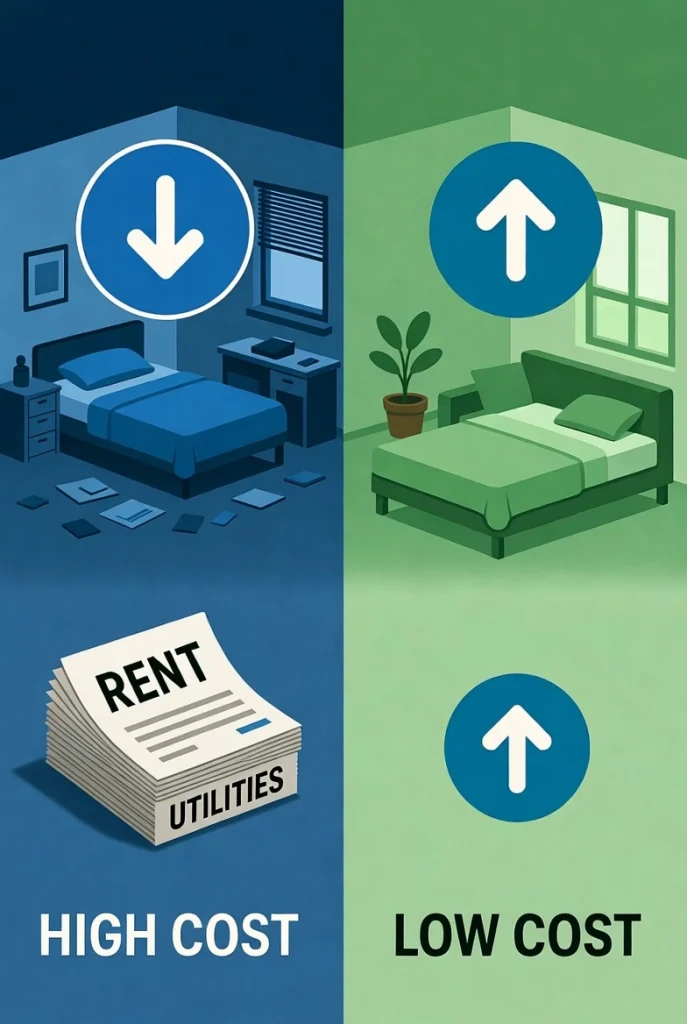
The image illustrates how simple changes can help cut living expenses 2026 and improve your overall financial situation.
5. Relocate to a More Affordable Market
If your work situation allows even partial remote flexibility, relocating to a city with meaningfully lower rents is the highest-impact single move on this list for total dollar savings. The difference in monthly rent between a major urban centre and a mid-size Prairie or Midwest city can be $800 to $1,500 per month for a comparable unit. Over 12 months that is $9,600 to $18,000 in saved housing costs, which is a substantial down payment contribution in itself. Prairie cities in Canada and mid-size Midwest and Southern cities in the USA consistently offer the most accessible combination of rent levels and employment options for 2026. For a market comparison, our 2026 housing affordability report covers where rents and purchase prices are most manageable across North America.
Strategies 6 to 12: Slash Your Utility Bills (Save $150 to $350 per Month)
6. Audit Your Current Energy Usage
Most people have no idea which appliances and habits are responsible for the bulk of their electricity and gas bills. Before making changes, do a quick audit. Your utility provider will often show your usage history online and may offer a free energy audit tool or even an in-home assessment. Identify your three to five biggest consumers, which are typically heating and cooling, water heating, laundry, and older refrigerators or freezers, and focus your behaviour changes there. Changing high-impact habits produces far more savings than obsessing over low-draw devices like phone chargers.
7. Install a Smart Thermostat and Adjust Temperature Habits
Heating and cooling account for roughly 40 to 50% of the average household energy bill. A programmable or smart thermostat that automatically reduces heating and cooling when you are asleep or away from home pays for itself within two to three months in most climates. In Canada, lowering your thermostat by just two degrees during sleeping hours and when the unit is empty can reduce heating costs by 5 to 10% per month. In the USA, the Department of Energy estimates that setting your thermostat back 7 to 10 degrees for 8 hours a day can save up to 10% annually on heating and cooling. If your landlord controls the building heating system, layers, door draft stoppers, and window insulation film are effective supplements that cost very little.
8. Switch to LED Bulbs and Eliminate Phantom Loads
LED bulbs use 75 to 80% less electricity than incandescent bulbs and last significantly longer. If you are still using standard bulbs in most of your fixtures, switching to LEDs is one of the fastest and cheapest efficiency upgrades available with payback measured in months. Phantom loads, the electricity drawn by devices in standby mode, account for roughly 5 to 10% of total household electricity use in most homes. Televisions, gaming consoles, cable boxes, computer setups, and kitchen appliances all draw power when not actively in use. Using smart power strips or simply unplugging non-essential devices when not in use eliminates this waste at no cost.
Washing clothes in cold water uses approximately 90% less energy than hot water washing and is just as effective for most everyday laundry. Running the dishwasher only when full and skipping the heated dry cycle reduces electricity consumption significantly. Avoid running the dryer during peak grid hours, typically late afternoon in most regions, if your utility provider offers time-of-use pricing. Defrosting freezers regularly improves efficiency. If you are purchasing appliances, Energy Star certified models use 10 to 50% less energy than standard models. These habits combined can reduce your electricity bill significantly.
Washing clothes in cold water uses approximately 90% less energy than hot water washing and is just as effective for most everyday laundry. Running the dishwasher only when full and skipping the heated dry cycle reduces electricity consumption meaningfully. Avoid running the dryer during peak grid hours (typically late afternoon in most regions) if your utility provider offers time-of-use pricing. Defrosting freezers regularly improves efficiency. If you are purchasing appliances, Energy Star certified models use 10 to 50% less energy than standard models depending on the appliance type. These habits combined can reduce your electricity bill by $40 to $90 per month.
10. Install Water-Saving Fixtures
Low-flow showerheads and faucet aerators are inexpensive, easy to install, and reduce hot water consumption without a meaningful impact on the shower experience for most people. A standard showerhead uses 2.5 gallons per minute. A low-flow head uses 1.5 to 2.0, which reduces both water and water-heating energy costs. Fixing or reporting a leaking toilet quickly matters significantly: a running toilet can waste 20 to 200 gallons of water per day depending on the severity of the leak, adding substantially to a water bill. Check with your landlord before making any fixture changes, as approval is typically required and they may cover the cost themselves given the long-term savings.
11. Shop Your Internet and Mobile Plans Annually
Internet and mobile providers regularly offer promotional rates to new customers that existing customers are not automatically given. Calling your provider annually and asking for a retention rate, or threatening to switch to a competitor, often produces a $20 to $40 per month reduction without changing your service level. Bundling internet and mobile with the same provider sometimes produces further discounts. In Canada, providers like Fido, Koodo, and Public Mobile consistently undercut major carrier prices on mobile. In the USA, MVNOs (mobile virtual network operators) like Mint Mobile and Visible offer reliable service at a fraction of major carrier costs. Switching one or both can save $40 to $80 per month in combined communications costs.
12. Apply for Utility Assistance Programs
Both countries have active programmes that help low-to-moderate income households with energy costs. In the USA, the Low Income Home Energy Assistance Program (LIHEAP) provides direct assistance with heating and cooling costs and is available in every state. Many utility companies also have low-income rate programmes and arrears forgiveness schemes that are not widely publicised. In Canada, provincial programmes such as Ontario’s Low-income Energy Assistance Program (LEAP), BC’s BC Hydro Customer Crisis Fund, and Alberta’s ASSIST programme provide help for eligible households. These are separate from rental assistance programmes and can stack with them. Our guide on free rental and housing assistance in 2026 covers how to navigate these programmes alongside rental help.

Strategies 13 to 15: Advanced Moves for Maximum Savings
13. House Hacking Lite
Full house hacking involves buying a multi-unit property and renting out part of it. But there is a lighter version available to renters: renting out a spare room, a parking space, a storage unit, or even a driveway to generate income that offsets your total housing cost. If your lease permits subletting or adding a paid occupant, a spare room rented for $700 to $1,100 per month in most urban markets dramatically changes your effective monthly housing cost. Even renting parking to a neighbour or listing storage space on a platform like Neighbor.com can generate $100 to $250 per month in passive offset income. For the full ownership version of this strategy, our guide on house hacking strategies for 2026 covers exactly how to get started with minimal capital.
14. Explore Community Solar and Green Energy Programmes
Community solar programmes allow renters to subscribe to a share of a local solar installation and receive credits on their electricity bill without installing panels on a property they do not own. Available in over 20 US states and growing in Canada, community solar typically produces electricity bill savings of 5 to 15% per month with no upfront cost and no changes required to your unit. Green energy tariffs from your utility provider can sometimes lock in competitive or below-market rates for 12 to 24 months. These programmes are worth investigating if they are available in your area, as they save money while your utility company handles everything operationally.
15. Relocate for Work and Housing Together
The most powerful single move for dramatically lowering total housing costs is combining a job change or remote work arrangement with a move to a significantly more affordable market. Someone who moves from Toronto or Vancouver to Edmonton or Saskatoon, or from New York or San Francisco to Indianapolis or Tulsa, is not just cutting rent. They are often also reducing utility costs (smaller units, different climate), eliminating commuting costs, and sometimes accessing employment with comparable salaries but a far lower cost of living. This is not a small decision, but it is the one that produces the largest sustained reduction in total housing costs for people who are open to it. Our guide to relocating for cheaper housing covers how to evaluate markets and make the transition practically.
Taking steps to cut living expenses 2026 should be a priority this week. Start with one small action and build momentum towards larger savings. It is crucial to begin implementing strategies effectively.
Potential Savings by Strategy Combination
As you work through these strategies, always remember that the goal is to cut living expenses 2026 efficiently and effectively.
| Strategy Combination | Monthly Savings (USD) | Monthly Savings (CAD) | Time to Implement |
|---|---|---|---|
| Rent negotiation + seasonal timing | $200 – $500 | $250 – $600 | 1 to 2 months |
| Utilities audit + behaviour changes | $80 – $150 | $100 – $200 | 1 week |
| Roommate + utilities split | $500 – $1,100 | $600 – $1,400 | 1 to 2 months |
| Assistance programmes (rent + energy) | $100 – $400 | $150 – $500 | 2 to 6 weeks |
| Full package: rent, utilities, and income offset | $600 – $1,200+ | $700 – $1,500+ | 1 to 3 months |
Where to Start This Week
Cutting your total housing costs in half will not happen in a single week. But you can absolutely start moving the needle immediately. Pick one action from the rent category and one from the utilities category and take a concrete step on both this week. Send one negotiation email. Call your internet provider. Look up whether LIHEAP or your provincial energy assistance programme applies to your situation. Small, consistent actions taken in sequence add up to significant savings over 60 to 90 days.
If your rent situation is creating broader financial stress, our guide on breaking free from the rent trap in 2026 covers the longer-term strategies that real people are using to move beyond month-to-month housing pressure. And our 2026 renters rights guide covers how to protect yourself legally while you work on reducing your costs.
Frequently Asked Questions
Is it actually possible to cut rent and utilities in half in 2026?
For many renters, yes, though it depends on your current situation and which strategies apply to you. If you are paying above-market rent with no roommate in a high-cost city, combining a negotiated rent reduction, a roommate arrangement, and utility efficiency changes can realistically produce 40 to 55% total savings. If you are already in a reasonably priced unit and live efficiently, the achievable savings are more modest, likely 15 to 25%. The more of these strategies you can combine, the closer to that 50% mark you can get.
Which single strategy saves the most money?
For pure dollar impact, adding a roommate to split both rent and utilities produces the largest single monthly saving, often $600 to $1,200 per month or more depending on your market. Relocating to a more affordable city produces even larger savings over time but requires more disruption. For people who want to stay in their current unit and situation, rent negotiation with comparable market data is the highest-leverage move, typically saving $150 to $450 per month with no disruption at all.
How much can I realistically save on utility bills without major changes?
Behaviour changes alone, including thermostat adjustments, cold-water laundry, unplugging phantom loads, and LED lighting, typically save $60 to $120 per month for an average household. Adding smart thermostat programming or applying for an energy assistance programme can push that to $100 to $200 per month. Major changes like switching to community solar or significantly upgrading appliances can push savings higher, but behaviour and habit adjustments produce meaningful results on their own with no upfront cost.
Can I negotiate utilities as well as rent?
If utilities are included in your rent, you can sometimes negotiate a cap or reduction as part of your overall rent discussion. If they are billed separately through your utility provider, you cannot negotiate the rate directly, but you can apply for low-income assistance programmes, switch to time-of-use pricing if your provider offers it, or negotiate retention rates with internet and mobile providers. Some landlords in all-inclusive arrangements are open to switching a tenant from all-inclusive to separate utility billing if that arrangement serves both parties, which can sometimes be cheaper if you are an efficient user.
Are utility assistance programmes available to working renters, not just those in poverty?
Yes. LIHEAP in the USA and provincial energy assistance programmes in Canada both have income eligibility thresholds that include working households, not just those at the lowest income levels. Eligibility limits vary by programme and household size but many programmes extend into moderate income ranges. It is worth checking your specific eligibility regardless of your income level, as many people who qualify never apply simply because they assume they would not meet the criteria.
References
- Zillow Rental Market Report 2026
- Rentals.ca Market Trends 2026
- Numbeo Cost of Living Data 2026
- U.S. Energy Information Administration: Residential Energy Use
- Natural Resources Canada: Home Energy Efficiency

I’ve spent several years researching U.S. and Canadian housing markets, with a focus on practical, data-driven strategies for everyday homebuyers. My goal is to make complex market trends easier to understand and help readers make informed real estate decisions. While I strive to keep all information current and accurate, housing markets change quickly, so always consult qualified real estate, financial, or professionals before making decisions.