
Finding affordable apartments for new renters in 2026 across the USA and Canada, particularly in the best rental markets Canada, is genuinely possible, but it requires knowing where to look and what to prioritise. First-time renters face a specific set of challenges: limited rental history, early-career income, and often no established credit profile, all in markets where landlords are competitive and standards have risen.
The mistake most new renters make is targeting cities where they want to live rather than cities where the numbers actually work at their income level. Getting your first apartment in the right market with the right approach sets up everything that comes after it. The best rental markets Canada offer numerous options for budget-conscious individuals.
This guide covers the most affordable markets in both countries specifically for new renters, what types of units offer the best entry points, and the practical steps that make the difference between a smooth start and a frustrating one.
Exploring the best rental markets Canada can significantly enhance your chances of finding affordable housing.
The 2026 Rental Reality for First-Time Renters
The best rental markets Canada provide essential insights for new renters looking for value and affordability.
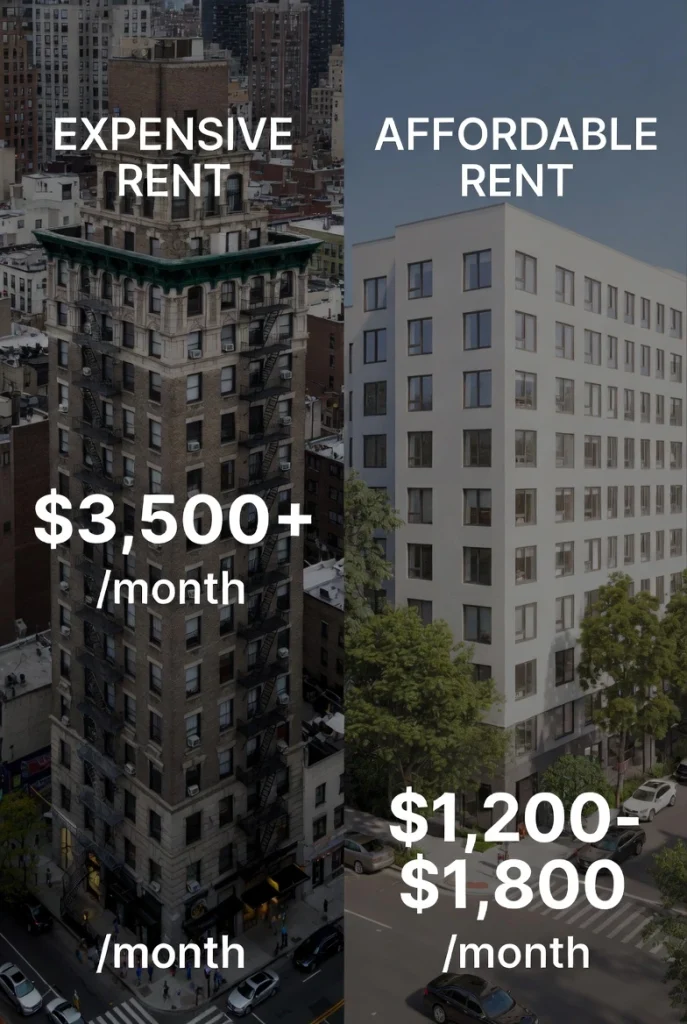
New renters in 2026, particularly those under 30 or on starting salaries, face more barriers than previous generations did at the same life stage. Rents in major cities across both countries have not meaningfully retreated from their pandemic-era peaks. Average one-bedroom rents in New York, Toronto, and Vancouver sit above $2,300 per month, and even mid-size cities have seen increases that strain entry-level budgets. The income-to-rent ratio that most financial advisors recommend, keeping total housing costs below 30% of take-home pay, is genuinely difficult to achieve in many markets without a roommate or a relocation to a more affordable city.
| Region | Average 1-Bedroom (USD) | Average 1-Bedroom (CAD) | Good for New Renters? |
|---|---|---|---|
| Major cities (NYC, Toronto, Vancouver) | $2,400+ | $2,300+ | Very difficult on starting salary |
| Mid-size cities (general) | $1,450 – $1,850 | $1,600 – $2,100 | Manageable with planning |
| Affordable markets (Prairies, Midwest, South) | $950 – $1,450 | $1,200 – $1,650 | Strong starting point |
Understanding the best rental markets Canada is crucial for first-time renters seeking budget-friendly options.
Top Affordable Cities for New Renters in Canada in 2026
In the best rental markets Canada, new renters can find affordable options while enjoying vibrant city life.
The best rental markets Canada offer various options for budget-conscious individuals.
Both Saskatoon and Regina stand out as part of the best rental markets Canada for those seeking economical choices.
Winnipeg is another excellent choice within the best rental markets Canada for budget-conscious newcomers.
Edmonton and Calgary, Alberta
Halifax is increasingly recognized as one of the best rental markets Canada, offering a blend of affordability and lifestyle.
Alberta’s two major cities offer the best combination of affordable rents, strong employment, and no provincial income tax of any major Canadian rental market in 2026. Edmonton one-bedrooms are available between $1,250 and $1,650 in most neighbourhoods, and Calgary sits slightly higher at $1,450 to $1,850. Both cities have active job markets in energy, healthcare, technology, and government that support entry-level and early-career employment. The higher vacancy rates in both cities, particularly Edmonton at around 6.8%, mean new renters with limited rental history have a better chance of being approved than they would in tighter markets. Landlords who need to fill units are more flexible on application requirements than those with waiting lists.
Saskatoon and Regina, Saskatchewan
For new renters whose absolute priority is the lowest possible monthly payment, Saskatchewan is the strongest option in Canada. One-bedroom averages sit below $1,300 in both Saskatoon and Regina, and the rental market’s high vacancy rate of around 7.2% in Saskatoon means application standards are accessible. Both cities have universities and colleges that create an infrastructure of services and social life that makes them more livable than their national profile might suggest. For someone starting out on a modest income who wants to build rental history, savings, and eventually credit for future ownership, these cities offer a financial runway that simply does not exist in major urban centres.
Winnipeg, Manitoba
In the context of the best rental markets Canada, Southern cities exhibit a compelling contrast to major urban centers.
Winnipeg sits in a middle ground that suits many new renters well. Rents are low relative to most Canadian cities, averaging around $1,320 for a one-bedroom, and the city offers a range of unit types including basement suites and older apartment buildings that come in under that average. Winnipeg’s employment market is diverse and stable, with healthcare, education, finance, and manufacturing all represented. The city is large enough to offer a complete urban lifestyle with transit, culture, and dining without the cost pressure of larger markets.
For first-time renters, understanding the best rental markets Canada can determine their housing experience.
Halifax, Nova Scotia
Halifax has grown significantly as a destination for young professionals and new graduates, with a job market that has expanded meaningfully in technology, ocean industries, and public sector employment. One-bedroom rents sit in the $1,500 to $1,900 range, which is more expensive than the Prairies but considerably cheaper than Ontario and BC major cities. Halifax offers a genuinely appealing quality of life: a compact, walkable downtown, strong university presence, ocean access, and a community character that is difficult to find in larger urban centres. For new renters who prioritise lifestyle alongside affordability, it is one of the best options in Atlantic Canada.
Top Affordable Cities for New Renters in the USA in 2026
Midwest Cities: Kansas City, Indianapolis, and Omaha
The US Midwest consistently offers the strongest combination of affordable rents, solid employment, and livability for new renters on starting salaries. One-bedroom apartments in Kansas City, Indianapolis, and Omaha are widely available under $1,200 per month, with newer buildings and better amenities available in the $1,200 to $1,500 range. All three cities have diversified employment bases in healthcare, finance, logistics, and technology that support entry-level career development. Cost of living beyond housing is also lower than coastal cities, meaning a starting salary stretches further in day-to-day expenses as well as rent.
Southern Cities: San Antonio, Memphis, and Oklahoma City
Southern US cities offer some of the lowest rents of any mid-size metropolitan areas in North America in 2026. One-bedrooms in San Antonio, Memphis, and Oklahoma City range from $900 to $1,400 depending on neighbourhood and building age. These cities have warm climates, lower general cost of living, and employment in healthcare, military and government, energy, and growing technology sectors. Memphis and Oklahoma City in particular have seen meaningful investment in downtown revitalisation and arts infrastructure over recent years, making them more appealing for younger renters than their historical reputation might suggest.
Smaller Texas and Florida Markets
While Austin, Miami, and Tampa have seen significant rent increases, smaller Texas and Florida markets remain relatively accessible. Cities like Lubbock and El Paso in Texas and markets like Gainesville and Pensacola in Florida offer one-bedrooms under $1,200 with strong local employment tied to universities, military installations, and regional healthcare systems. These markets suit new renters who have employment reasons to be in these states but want to avoid the high costs of the major metropolitan centres.

What New Renters Should Look for in an Apartment in 2026
Beyond location, the type of unit you target significantly affects both your monthly cost and the smoothness of your first rental experience.
- Studio or junior one-bedroom. The cheapest entry point in most markets. For a first rental where the goal is building history and keeping costs low, a studio or junior one-bedroom is the right size. You can always upgrade once your income and rental history are established.
- Utilities-included buildings. When you are new to renting, managing separate utility accounts on top of rent adds administrative complexity and variable monthly costs that are hard to budget for. An all-inclusive rent that covers heat, water, and sometimes electricity removes that uncertainty and often results in lower overall monthly costs in winter months.
- Older but well-maintained buildings. Purpose-built rental buildings from the 1970s and 1980s in decent neighbourhoods almost always rent for less per square foot than new luxury towers. Finishes are less polished, but the units are typically larger, better insulated, and managed by landlords who have long-term tenant relationships rather than short-term yield targets.
- Good transit access. For new renters who do not yet need a car, strong transit access eliminates $400 to $700 per month in vehicle ownership costs and expands the range of neighbourhoods where living car-free is practical.
- Flexible lease terms. Some smaller landlords and older buildings offer 6-month leases, which gives new renters flexibility if their job situation changes or if they decide the city is not the right fit. It is worth asking about shorter initial lease options, particularly in markets with higher vacancy rates.
Smart First Steps Specifically for New Renters
- Build rental history deliberately. Your first rental is not just housing, it is the beginning of a track record that future landlords will check. Pay on time every month without exception. Communicate professionally. Leave the unit in good condition. That history becomes one of your most valuable assets in every future rental application.
- Use a cosigner if your income or credit is thin. Many landlords accept a cosigner for first-time renters who cannot meet standard income or credit thresholds on their own. A parent or family member with established credit and stable income can make approval possible in markets where you would otherwise be turned down. Always formalise any cosigning arrangement clearly so both parties understand the obligations involved.
- Apply the 30% rule strictly. Keep total monthly housing costs, rent plus utilities, below 30% of your actual take-home pay, not your gross income. If a unit does not meet this threshold, it is the wrong unit regardless of how appealing it is. Starting with a financially manageable home is more important than starting in the ideal location.
- Document the unit thoroughly on move-in day. Walk through every room with your phone and photograph everything: walls, floors, appliances, fixtures, and any existing damage. Send the photos to your landlord by email immediately so there is a timestamped record. This documentation is your protection when you move out. Our 2026 renters rights guide covers your full legal protections in both countries including exactly what landlords can and cannot deduct from your deposit.
- Ask about move-in specials before agreeing to a price. In markets with higher vacancy, many buildings offer one free month, reduced security deposits, or waived parking fees to new tenants. These incentives are often not advertised and will not be offered unless you ask. A simple “Is there any move-in flexibility or any current specials available?” before you commit is worth the 10 seconds it takes.
USA vs Canada: Key Differences for New Renters
| Factor | USA | Canada |
|---|---|---|
| First apartment cost in affordable markets | Lower in Midwest and South cities | Competitive in Prairie cities |
| Security deposit rules | Usually 1 to 2 months; varies by state | Usually 1 month maximum; strictly enforced |
| Tenant rights and protections | Varies significantly by state | Generally stronger protections across provinces |
| Application focus | Credit score and income ratio heavily weighted | More balanced; rental history and references carry more weight |
| Cosigner acceptance | Widely accepted in most states | Accepted in most provinces with proper documentation |
| Rent increase limits | Active controls in some states and cities only | Most provinces have annual increase guidelines |
For a detailed breakdown of what your legal rights are as a renter in either country once you have signed a lease, our 2026 renters rights guide for the USA and Canada covers everything from hidden fees to illegal rent increases to deposit deduction rules. Knowing these rights before you sign is considerably more useful than discovering them during a dispute.
The Path from First Apartment to Financial Stability
In conclusion, the best rental markets Canada encompass various cities that cater to new renters.
Your first rental is the start of a financial progression, not a permanent situation. The goal of the first apartment is to establish rental history, keep costs low enough to save consistently, and build the credit and financial profile that opens better options over time. New renters who over-extend on their first apartment often spend years treading water financially. Those who start in an affordable market or a smaller unit, pay on time, save aggressively, and build their profile methodically are typically in a fundamentally different financial position within two to three years.
Once you have a year or two of rental history, a stable income, and some savings built up, the question of whether to continue renting or start planning toward ownership becomes a realistic one. Our 2026 rent vs buy comparison walks through the numbers across different market types so you can start thinking about that next step at the right time. And if high rent is currently preventing you from saving as much as you should be, our guide on cutting rent and utility costs in 2026 covers 15 strategies that work even on a first-renter budget.
Frequently Asked Questions for First-Time Renters
With an emphasis on the best rental markets Canada, the transition from renting to ownership becomes more feasible.
New renters should focus on the best rental markets Canada to maximize their investment in housing.
The best rental markets Canada can significantly influence your rental journey and financial health.
What credit score do I need to rent my first apartment in 2026?
Understanding how to navigate the best rental markets Canada is essential for new renters.
Requirements vary by landlord and market. Large corporate property managers typically want a score of 620 or higher in the USA, and many Canadian landlords look for similar benchmarks. Private landlords are more flexible, particularly in markets with higher vacancy rates. If your credit score is thin or low, focusing on markets with higher vacancy, targeting private landlords, providing a strong application package with income and reference documentation, and offering a cosigner are all strategies that overcome limited credit history. For specific guidance on renting with credit challenges, see our guide on renting with bad credit in 2026.
How much income do I need to rent a one-bedroom apartment in 2026?
Choosing among the best rental markets Canada is vital for achieving financial stability through renting.
Addressing concerns in the best rental markets Canada can streamline the apartment hunting process.
Most landlords use a gross income threshold of two and a half to three times the monthly rent as a minimum standard. For a $1,300 per month one-bedroom, that means a gross income of roughly $3,250 to $3,900 per month, or approximately $39,000 to $47,000 annually. In affordable markets like the Prairies or US Midwest, this is achievable on many entry-level salaries. In major cities where one-bedrooms start at $2,000 to $2,500, the income requirement becomes $60,000 to $75,000 annually, which is out of reach for many early-career earners.
Should I get a studio or a one-bedroom for my first apartment?
For most new renters whose primary goal is financial stability, a studio or junior one-bedroom is the right starting point. The cost difference between a studio and a one-bedroom is typically $150 to $300 per month, which compounds into $1,800 to $3,600 in savings over a year. The trade-off is less space, which matters more for some lifestyles than others. If you work from home and need a dedicated workspace, a one-bedroom is worth the premium. If you are away from home frequently or can manage a combined living and sleeping space comfortably, a studio gives you more financial flexibility.
Finally, exploring the best rental markets Canada can pave the way to a more secure rental experience.
What should I look for when viewing my first apartment?
Beyond the obvious factors of size, location, and price, pay close attention to: water pressure and hot water supply, signs of moisture or mould in bathrooms and under sinks, the condition of windows and whether drafts are evident, the responsiveness and professionalism of the landlord during the viewing, noise levels at different times of day, laundry access, and the condition of shared spaces if applicable. Take photos during the viewing even before you move in. Ask specifically about what utilities are included, how maintenance requests are handled, and whether there is a building manager on-site or the landlord manages remotely.
How do I build rental history as a first-time renter?
Rental history is built through documented, on-time payment and positive landlord references. Pay every month on time, preferably via a method that creates a paper trail like bank transfer or cheque rather than cash. Communicate clearly and professionally with your landlord when issues arise. Maintain the unit in good condition. After 12 months, you can ask your landlord for a written reference confirming your payment history and tenancy conduct. That reference is one of the most valuable documents you will carry into future rental applications, and it means more in many cases than a credit score because it represents direct evidence of how you actually rent.
References
- CMHC Rental Market Report 2026
- Rentals.ca National Rent Data 2026
- Zillow Rental Market Data 2026
- HUD.gov: US Tenant Rights

I’ve spent several years researching U.S. and Canadian housing markets, with a focus on practical, data-driven strategies for everyday homebuyers. My goal is to make complex market trends easier to understand and help readers make informed real estate decisions. While I strive to keep all information current and accurate, housing markets change quickly, so always consult qualified real estate, financial, or professionals before making decisions.